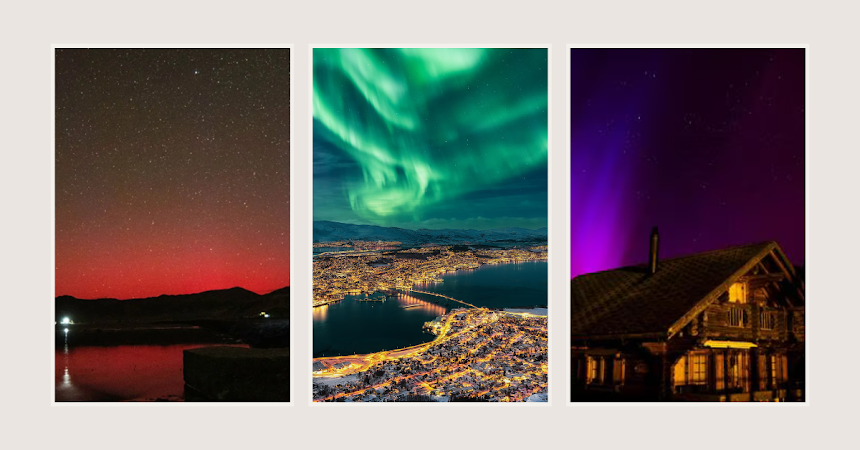


For skywatchers around the world, the weekend of May 10th, 2024, was one for the history books. A series of powerful solar storms unleashed a dazzling display of the aurora borealis, commonly known as the northern lights, across the Northern Hemisphere. This celestial phenomenon, usually confined to the high-latitude regions near the Arctic Circle, stretched its reach further south than ever before, captivating audiences in unexpected locations like Alabama and northern California.
A Collision of Earth and Sun: The Science Behind the Light Show
The aurora borealis is a breathtaking dance of light in the night sky, caused by a collision of charged particles from the sun with Earth's atmosphere. These energetic particles, primarily electrons and protons, are ejected from the sun during solar flares and coronal mass ejections (CMEs). When they reach Earth's atmosphere, they interact with the gases, primarily oxygen and nitrogen, causing them to be excited. As these excited atoms and molecules return to their ground state, they release energy in the form of visible light, creating the colorful auroras we witness.
The intensity and color of the aurora depend on the type of gas molecules involved in the collision and the energy level of the incoming particles. Oxygen typically produces green and red auroras, while nitrogen emits a blue or violet hue.
Image courtesy: Mint
A Historic Geomagnetic Storm Ignites the Night Sky
The spectacular display of the northern lights was fueled by an unusually strong geomagnetic storm. On Friday, May 10th, a G5 geomagnetic storm, the most severe level on the ranking scale, impacted Earth. This powerful storm, the first of its kind in decades, arrived amidst a series of CMEs, further intensifying the auroral activity.
The National Oceanic and Atmospheric Administration's (NOAA) Space Weather Prediction Center (SWPC) played a crucial role in tracking and forecasting the solar activity. They issued a geomagnetic storm watch in anticipation of the G4 or G5 events likely following the upcoming CMEs. This rare "watch" level advisory highlighted the potential for the aurora to become visible over a vast swathe of the Northern Hemisphere.
Image courtesy: IAS Gyan
A Global Spectacle: From North America to Europe and Beyond
The weekend witnessed a global phenomenon. Breathtaking displays of the northern lights were reported from various locations across North America, Europe, and even Asia. Images and videos flooded social media, showcasing the aurora's vibrant colors shimmering across the night sky.
In the United States, the lights were visible as far south as Texas, Washington, and even parts of California. Images captured the aurora illuminating landmarks like Lake Washington in Renton, Washington, and thrilling skywatchers across the country.
Canada, no stranger to the aurora borealis, also experienced a spectacular display. The vibrant lights danced above iconic locations like Jericho Beach in Vancouver, British Columbia, leaving onlookers mesmerized.
Across the Atlantic, Europe witnessed its own share of the celestial spectacle. The United Kingdom, with its generally lower latitudes compared to Canada and Alaska, enjoyed a rare opportunity to witness the aurora. Images captured the lights shimmering over The Roaches near Leek, Staffordshire, creating a moment of wonder for British skywatchers.
The phenomenon wasn't limited to North America and Europe. Even in Asia, the powerful solar storms allowed skywatchers to witness the elusive aurora borealis. Images emerged from the Chinese autonomous region of Inner Mongolia, showcasing the vibrant greens and purples illuminating the night sky.
Image courtesy: Mint
A Once-in-a-Lifetime Experience: The Impact of the Aurora
The appearance of the aurora borealis at such low latitudes was a rare and awe-inspiring event. It provided a glimpse into the dynamic nature of our solar system and the profound impact the sun can have on Earth's atmosphere. For many, it was a once-in-a-lifetime experience, fostering a sense of wonder and appreciation for the beauty and power of natural phenomena.
The event also served as a reminder of the importance of space weather monitoring and forecasting. Organizations like NOAA's SWPC play a vital role in tracking solar activity and its potential impact on Earth's infrastructure and communication systems.
Image courtesy: ABC News
A Look to the Future: Will We See Another Such Display?
While the recent solar storms and subsequent auroral displays were exceptional, predicting the exact timing and intensity of future events remains a challenge. The sun goes through cycles of activity, with periods of high solar flare and CME frequency interspersed with calmer times.
However, the recent event highlights the potential for future geomagnetic storms to create spectacular auroral displays. As our understanding of space weather continues to evolve, so too will our ability to forecast and prepare for these events.
The weekend's celestial spectacle serves as a powerful reminder of the interconnectedness of our universe. It leaves us with a sense of wonder for the beauty and power of the natural world, and a thirst for further exploration and understanding of the cosmos.
Image courtesy: National Geographic
4 FAQs About the Spectacular Global Northern Lights Display
The recent dazzling display of the northern lights across the Northern Hemisphere has captivated audiences worldwide. Here are 4 frequently asked questions to quench your curiosity about this celestial phenomenon:
Q1.What caused the recent widespread aurora borealis displays?
Ans: A series of powerful solar storms, including a historic G5 geomagnetic storm, bombarded Earth's atmosphere over the weekend of May 10th, 2024. These storms unleashed a torrent of charged particles that collided with Earth's atmosphere, triggering the vibrant auroral displays.
Q2.Why were the northern lights visible at such low latitudes?
Ans: The unusually strong G5 geomagnetic storm disrupted Earth's magnetosphere, the region that shields our planet from charged particles. This weakened defense allowed the energetic particles to penetrate deeper into the atmosphere, causing the aurora borealis to be visible at much lower latitudes than usual.
Q3.Where were the northern lights visible during this event?
Ans: The global nature of the event made the aurora borealis visible in unexpected locations. Reports and images emerged from across North America, Europe, and even parts of Asia. In the United States, the lights were seen as far south as Texas, Washington, and even California. Similarly, in Europe, the aurora illuminated skies in the United Kingdom, a region typically outside the usual auroral zone.
Q4.Will we see another such spectacular display of the northern lights anytime soon?
Ans: Predicting the exact timing and intensity of future solar storms and auroral events remains a challenge. However, the sun goes through cycles of activity, with high solar flare periods followed by calmer intervals. The recent event highlights the potential for future geomagnetic storms to create stunning auroral displays. As our understanding of space weather continues to improve, so too will our ability to forecast and prepare for these captivating celestial phenomena.